Brendan Gregg from Sun’s Fishworks team makes an interesting discovery about inducing disk latency. Don’t try this yourself.
Tag Archives: video




Professional Videography vs. Videoblogging
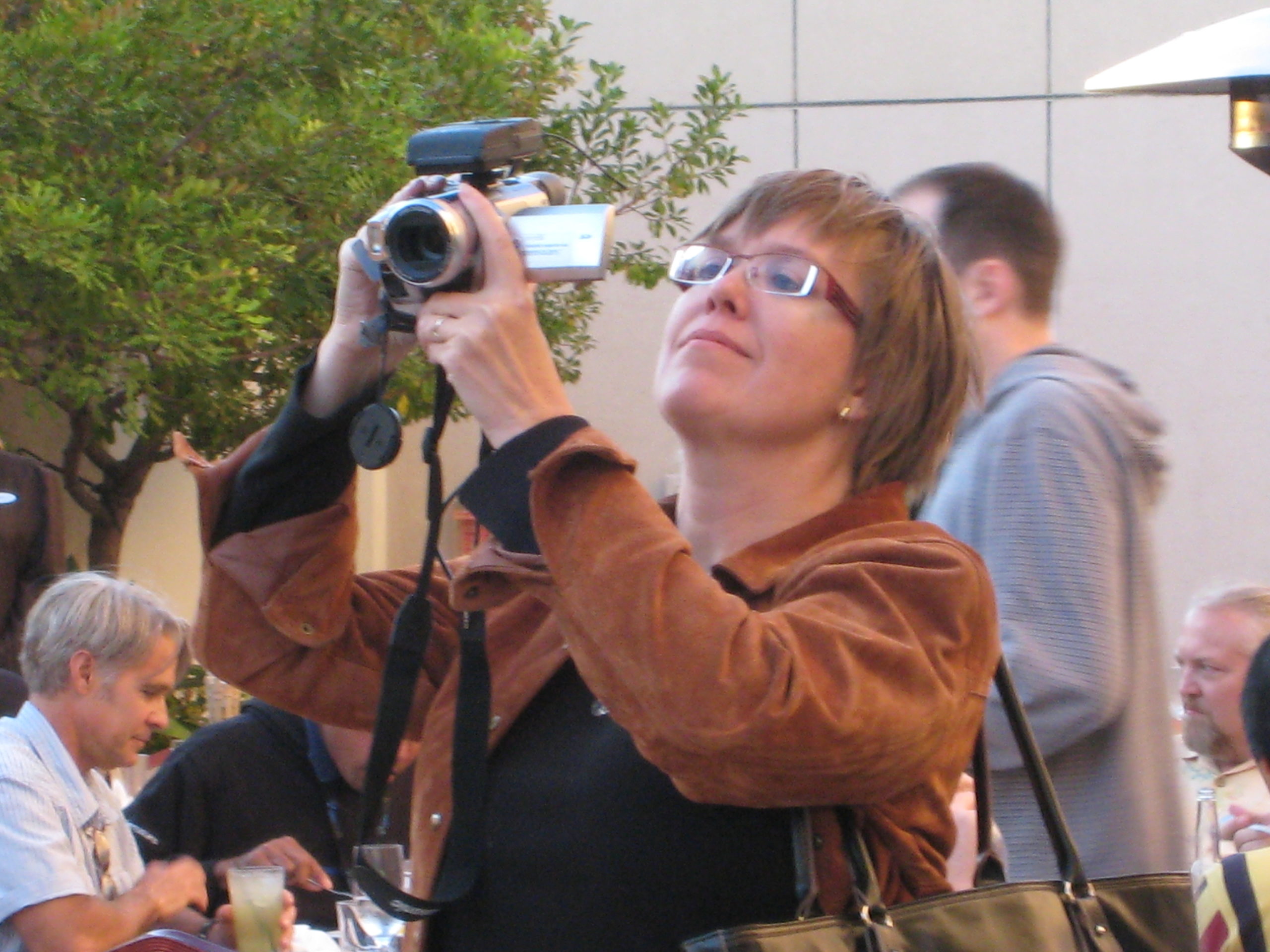
^ filming at the Open Storage Summit after-party
I don’t claim to be a professional videographer (for one thing, I’m entirely self-taught). I do videoblogging, which is fundamentally different.
From my (very limited) experience, it seems that professional corporate video is, usually:
- thoroughly planned (and likely scripted) in advance;
- involves quite a lot of large, heavy equipment, with multiple people to set it up and run it.
- the people who do this know how to do media, but don’t necessarily know much about what or who they’re filming (nor do they need to).
- filming often takes place in a studio, which may need to be reserved well in advance, or in some other carefully-planned, controlled location;
- professional post-production (editing, compressing, and posting video) can take a long time
- all of this is expensive
Videoblogging, on the other hand:
- eh… not so planned. When I go to an event, I have an idea which talks I want to film, but things usually get added or subtracted at the last minute. Alongside the formal talks, I also try to grab interviews and other material.
- equipment is minimal and light, reasonable for one person to move around and manage.
- a videoblogger is part of the community, and therefore can see and take advantage of filming opportunities as they arise – or create them.
- shooting can take place anywhere – no reservation required.
- post-production is quick and dirty – the important thing is to get the material out FAST
- all of this is cheap


My New Baby

Isn’t it gorgeous? It’s my very own Thumper, aka Sun Fire X4500 Server.
Jeff Cheeney and I (and whoever we can rope in to help) are going to make it into a video compression/archive/streaming server. (Before you start worrying about budget, don’t: this one is rebuilt and didn’t cost us anywhere near sticker price.)
Why do I need such a thing? Take a look:

I’ve shot over 100 hours of video since I began videoblogging for Sun about a year ago, and much more is on the way. I haven’t edited even half of it, partly because I’m doing all the editing and compression a Windows laptop which I also have to use for all my other work. So it would be useful to be able to offload some of the processing onto a different machine, one that can also archive and share the results.
This is also a learning exercise, to see what we can do with all this cool technology we have around, similar to the project that Jeff and Chase distilled into a ten-minute recipe for building a NAS box. Similar also to Dominic’s new recipe series, which began recently with Configuring Sun Storage J4000 Arrays and the ZFS File System in Ten Minutes.
It will probably take some months of poking around and figuring things out, and we’re not entirely sure we’ll be able to boil this one down to “Build a Video Archive/Server in 10 Minutes” – but that’s what we’re trying for. We’ll keep you posted!
You might also like:
Caffeination: Italians and Their Coffee
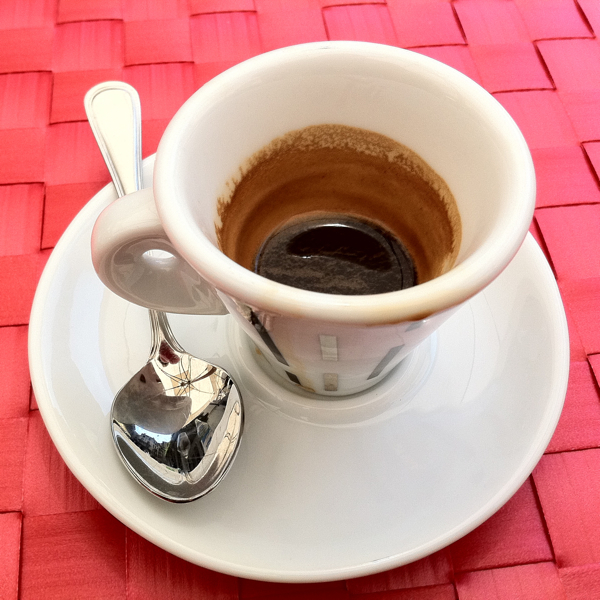
Although Italy has some of the best coffee in the world, Italians don’t drink nearly as much of it as you might think. My own routine, which I suspect to be fairly average, is:
- one at home at 7:30, before starting my commute
- one fairly soon after arriving at work, around 10 am
- one right after lunch
If I’m having a particularly sleepy day I might have one sometime between 10 and 1 (pre-lunch) and/or, very rarely, one in the late afternoon. Five a day is unusual for me, and many people I know consider four overdoing it ¬– though I did talk to a barista once who said he used to drink 12 espressos a day.
Most people I’ve observed in this part of the country (Milan / Lombardia) stop with the post-lunch espresso. Some have an espresso after dinner, especially if they plan to be out later, but I don’t see many ordering post-dinner coffees in restaurants. At home we only make coffee at night if dinner guests want it for their own drives home.
It’s true that espresso is concentrated, but, per average serving, it contains less caffeine than American coffee, and Italians do not have the American habit (which I sometimes miss) of keeping a warm mugful on your desk or table and sipping at it for hours.
When foreigners come to Italy, the clash of caffeine culture can be funny. A Swedish colleague once apartment-sat for us in Milan. As part of his orientation, I took him downstairs to our usual coffee bar (which also made excellent gelato), introduced him, and asked them to treat him nicely. They talked for months afterwards about his peculiarities: he habitually ordered double espressos, which baffled them. For starters, a double won’t fit in the standard single espresso demi-tasse cup, and they disliked the aesthetics of serving espresso in a cappuccino cup. He also mostly lived on gelato that month (it was August), which, while they appreciated the compliment to their gelato, is not standard Italian behavior!
The other day, I overheard a young Italian woman on the train discussing a foreign guest who had visited their home. “We made a moka of coffee, and she thought it was all for her. She drank the whole thing!” “I could never drink that much coffee!” exclaimed her friend, “I wouldn’t sleep for days!”
When Italians make coffee at home, they most often use the moka, a screw-together pot you put on top of the stove. These come in capacities from 1 to 10 cups, and a family may own several sizes, to cope with various occasions. But a four-cup moka makes less coffee than you’d find in a Starbucks “tall” – no wonder the American guest was confused.
Yes, you can get fancy home espresso machines here just as you can in the US, but, to make consistently good espresso, they require a high degree of maintenance and skill. Most Italians can’t be bothered, especially when they can get better coffee for far less fuss at the bar down the street. (Though a few make it a point of fetishistic pride to be able to make at home a coffee “just as good as you get at the bar.” In counterpoint, some espresso machines in bars are decorated with the slogan “REAL coffee you can only get at the bar.”)
Coffee made in the moka can also involve more or less fuss, and is quite a different thing from bar espresso. It took me years to acquire the taste, and I still haven’t learned to make it consistently good. But I got tired of trying to reproduce the consistency and flavor of good American-style filtered coffee. I think that this winter, when I want a big hot drink, I’ll stick to chai.

Muvee: Fun Software for Home Music Videos
Some months ago I was invited to try Muvee AutoProducer software (and become an affiliate marketer – if you click on the banner at the bottom of this page and buy the software, I get a cut).
I didn’t have a lot of time to play with it then, and my first reaction was that this software, while cute, would be of limited interest to hard-core videobloggers – it just doesn’t give you enough control. Then, at CES, Jack Olmsted raved about it to me, and said it was far more flexible than I had realized. More recently, it came to mind when someone asked in the videoblogging group:
“I’ve got a large number of hour-long digital video tapes of my family sitting on the shelf.  I’d like to share key clips of these with my family and friends, but am turned off by the hassle of culling through each tape manually to find the most interesting clips (it seems that 80% of the time, the camera is just rolling and my kids aren’t doing anything too interesting to anyone else but me and my wife).  Is there an easy way to solve this online…?”
Online, I don’t think there is, but it occurred to me that Muvee might be a fun solution for him. So I decided to try it out again, and the Muvee lady graciously sent me a product key so I could try it at no charge.
The process (as explained in Muvee’s helpful startup window), is simple: select the video clips and/or photos and music you want to use, select an “editing style,” then select Make Muvee.
The first time around, this can be slow (especially with large videos) as Muvee analyzes all the material you’re using. But this analysis is only performed once, so you can make changes to your project and test it again very quickly.
Muvee is essentially designed to make music videos using your own video and/or photos; it assumes that you are going to add an audio soundtrack, probably a song. The two samples shown here illustrate this:
Test One – Our Smiling Cat
This Muvee includes about 10 clips from Ross’ digital still camera, plus a bit of video shot with my Canon digital video camera.
I used Muvee’s “simple music video” style.
music: James Taylor “Your Smiling Face”
Test Two – Beautiful Baby
This one uses only still photos, with Muvee’s “personal” style.
The effects on still photos (zooming in or out, panning across) can be done automatically by Muvee. I didn’t like what it was doing by default, so I used Muvee’s magicSpot settings on most of the photos to control “camera movement”.
Muvee produces video in MPEG1, MPEG2, WMV, AVI, DivX, and MOV (Qucktime) formats. I used my usual Sorenson Squeeze software to compress it into FLV (Flash) format for viewing on this page, so don’t judge the quality of Muvee’s video output by what you see here.
My conclusion is still that Muvee won’t be appealing to videobloggers like myself who need a lot of editing control. But it’s a lot of fun for the casual user who wants to create personal videos to share with friends and family, quickly and easily.
I’ll be playing with it some more as I have time and will post the results here.