Product Placement

Amazon, always the pioneer, is experimenting with Amazon Theater, a series of short films freely available (including for download) on Amazon.com. I noticed these a few weeks ago, but didn’t get around to watching any til today, back for my nth Christmas-shopping visit, when Chris Noth caught my eye. Always happy to look at him, so let’s watch this film, “Tooth Fairy.” Hmm. Multi-racial family. How nice. How PC. Typical American movie house – huge, full of stuff. (Since I’ve been living in Italy, that’s something I notice. I was distracted during “Thelma & Louise,” thinking: “Why do they have so much junk in their house?”) But these people have a LOT of stuff, including a den with a drum kit and foosball table. A rich family, evidently. Pool, balcony full of hanging plants, and a security guard driving around at night.

Okay, cute little movie, nothing special, I didn’t laugh. Then the credits roll. “Director – somebody Scott. Starring – Chris Noth. Cast in order of appearance: Cookware – Calphalon Tri-Ply…” Huh? The other human actors are listed below the cookware, interspersed with t-shirts, kitchen stuff, and tools. Each product name is a link to the appropriate Amazon page where you can buy the item (Chris Noth is also a product).

Product placement is common in movies and TV shows with contemporary settings – part of the reason I like costume drama is that it gives me a break from the barrage of advertising. I suppose Amazon has merely taken the trend to its logical extreme, by giving the products equal billing with the actors. I wonder how the actors feel about that. At what stage in your career can you be assured of being listed above, say, a socket wrench?

As a small rebellion against the inescapability of advertising in modern life, I have started peeling the labels off shampoo bottles etc. as soon as I get them home. Now at least I can take a bath without the packages screaming at me. So if you have occasion to take a bath or shower at our house, you’ll have to read the backs of the bottles to determine which is the shampoo, liquid soap, bath foam, etc.

Dec 7, 2004

John Francini responds:

Part of the reason that places like Amazon, and advertisers in general, think they need to do this product-placement nonsense is very simple: the TV audience is becoming highly fragmented. 30 years ago in the US there were exactly three commercial TV networks, plus PBS. If people watched a program aired nationally, they watched it on one of those three networks. It was effectively a “captive” market for advertisers: they could reach tens of millions without breaking a sweat.

Now, as you know, it’s substantially different: my cable system has some 200+ channels, and the audience is fragmented in many different ways. There are very few programs in the US that pull the kinds of audiences that advertisers used to see regularly – the Superbowl, and maybe the late stages of the baseball playoffs and the World Series (which certainly did this year, with the Red Sox breaking the Curse.)

The audience is also getting much better at tuning out the noise of advertising. So, in this incessant battle, the advertisers are trying new tactics, such as product placement in shows, or producing shows themselves. (BMW, for example, has a highly successful miniseries that’s only available on the Net. It seems to be aimed straight down the middle of their target audience, and hits it dead on.)

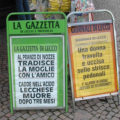
And of course, in the typical American supermarket, packaged goods makers do their last bit of screaming at the customers, in the form of ever-more-splashy graphics and loud labels. Why? Because while all these brands are struggling to rise above the visual noise of a crowded marketplace, we’re tuning it all out.

In fact, until you brought it up, I hadn’t even thought about how loud some of the packaging is – I’d tuned it all out long ago. It seems marketers have been visually screaming at us for decades. One local Boston example: Fenway Park, where the Red Sox play, has the fabled Green Monster. Did you know that, as recently as 1947, the wall wasn’t green, but was off-white and covered with a dozen or more ads? And the highways and byways of American roads were far more littered with billboards than they are now? Plus ça change, plus c’est la même chose…

Montorfano: A Medieval Village Above Lago Maggiore

In November of 2004 we visited Montorfano, a village near Lake Mergozzo, just north of Lago Maggiore.

It’s famous for the Romanesque church of St. John the Baptist, built in the 11th or 12th century (photos below).

above: This, I suppose, is the “orphaned mount” from which the town gets its name.

Romanic church of St. John the Baptist, built in the 11th or 12th century

Romanic church of St. John the Baptist, built in the 11th or 12th century

Romanic church of St. John the Baptist, built in the 11th or 12th century

ruins of much earlier buildings, dating from the 5th or 6th and 9th centuries.

^ next to the church, ruins of much earlier buildings, dating from the 5th or 6th and 9th centuries.

an ancient waterway, used in transporting granite from a local quarry

an ancient waterway, used in transporting granite from a local quarry.

a house in the village with a Peace flag

^ a house in the village with a Peace flag

old stone road

old stone road

steps up to the restaurant where we ate lunch. These steps were originally build to get granite down from the quarry

steps up to the restaurant where we ate lunch. These steps were originally build to get granite down from the quarry

same path, on the way back down

same path, on the way back down

Silver Threads Among the Gold

One thing I do like about my hair is its color. When I was little it was white-blonde, partly because I lived in Bangkok and spent a lot of time out in strong sunlight. It darkened as I got older, to its present ash-blonde, with random (and completely natural) patches of lighter and darker color here and there. A very cliché gay hairdresser I went to, years ago, gasped in delight: “I just LOVE your streaks!”

Now I’m getting my first white hairs, and I rather like the effect. The individual hairs are thicker than my other hair, so they spring out and catch the light, sparkling against the soft tones of the rest. I don’t think I’ll mind at all when my hair eventually goes completely white.

What’s in a Title? Signora vs. Signorina in Italy

I’m 42 today and, waking up with blue circles and bags under my eyes, I look it. Well, that’s the result of two days on my feet in the kitchen, cooking for 35 people (yes, I did have lots of help – thank you, Shannon!) for our annual Thanksgiving/ birthday/ housewarming feast (the housewarming part is not meant to be annual). Most of the time, people say I look young for my age, and I don’t think it’s just idle flattery.

I’ve been trying to understand the logic by which Italians decide to call me signora (Mrs.) or signorina (Miss). When Ross was small and I was in daily contact with her teachers and other parents at her schools, I was accustomed to being signora, because everyone assumed that, as a mother, I must also be a Mrs.

This signora habit almost got me arrested once. I was getting off the bus in Milan, in a hurry to pick up Ross from daycare, and swept right past the squad of public transport inspectors doing one of their random checks. I completely ignored the calls behind me of “Signorina! Signorina!,” assuming they couldn’t be directed at me. So the inspectors thought I was running away to dodge a fine for travelling without a ticket (actually, I am always scrupulous about bus and train tickets, except when I forget to stamp them).

I’m often called signorina even now. This may be because I often dress informally, by Italian standards, in jeans and sweaters. In a business suit and heels, I’m almost always signora. On some occasions, the choice of address seems to be based on the speaker’s desire to flatter me, and which term they think will accomplish that.

What’s in the Apple Name? Quality and Support Problems with iPods

Even marketers can get fooled by brand reputation. My daughter asked for an iPod for her birthday this summer. While normally somewhat cautious in buying electronics, I didn’t think twice about this – it’s Apple, right? They have a reputation for customer satisfaction and reliable hardware, right? Um, well… That reputation is no longer deserved, as far as I can tell.

I bought the iPod through Amazon (a good customer experience, but that’s another story) and had it sent to Ross at summer camp, knowing that it would be cheaper in the US, though she couldn’t use it til she got home. When she did, I installed the iTunes software on my Windows computer and connected the iPod. It worked well enough at first; we put over 800 songs on the 15 GB iPod – about 1/3 of its capacity. The connection to the computer was flaky from the start; I frequently had to reset the iPod before I could disconnect it. Then Windows just stopped seeing the iPod altogether. It still gets power through the FireWire cable and can be recharged, but the Windows operating system doesn’t find it.

That was when – too late – I did my homework. A browse through the Apple site revealed that:

  • many, if not most, Windows iPod users have similar problems
  • Apple support is unreachable online. There is no way to email them a query; all you can do online is send a request for a service number to send it back for warranty service.

After mentioning the iPod problems in an earlier newsletter, I heard from several people about similar problems, plus a problem I haven’t run up against yet: apparently the iPod’s rechargeable battery tends to go permanently flat just after the one-year warranty expires, and Apple will charge you $200 to replace it. See one customer’s response to this. However, on another site I learned that it’s not difficult to replace the battery yourself, for only about $40.

I borrowed a Mac, assuming that it would easily see the iPod and I could at least get it filled up with songs to keep Ross happy for a while. To my chagrin, the problem is exactly the same: the iPod can get power through its FireWire cord, but the Mac operating system can’t see it any more than Windows could. Also, to my surprise, it is easy to crash the iTunes software even on its native Mac platform. At least, it’s easy for me. I always manage to use software in ways that no one else does, so I’m very good at discovering bugs (programmers both love and hate me for this). But I really expected better from Apple, at least on their home turf.

Before I go to the hassle and expense of sending the iPod back to Apple (which I may have to do in the US, since I bought it in the US), I want to try a different cord and see if maybe the problem is there. Turns out that a friend of Ross’ also has an iPod, so we’ll try to borrow his cord. Interestingly, he also has a problem with his iPod: if he takes it jogging, it sometimes shuts off and can’t be turned on again until its battery has completely run down and then recharged.

Ross’, in the meantime, seems to have developed a mind of its own, turning itself on in the middle of the night with a series of loud beeps, and then starting to play.

So much for placing one’s faith in a brand. The Apple iPod: it’s cool, it’s trendy, it’s from Apple – buy it at your own risk.

Deirdré Straughan on Italy, India, the Internet, the world, and now Australia